I am an environmentalist adventurer. I strive to be as "green" as I can and encourage others to do their little bit.

My job is an Education Specialist/Zoo Adventure Coordinator at the El Paso Zoo. Basically, I create and present classes, programs and workshops that are fun, educational and inspire participants to conserve in their everyday lives.

My journey is full of thoughts, wildlife, food, conservation and adventures! So keep up!

Tuesday, November 1, 2011

Happy Halloweeeeen!

Happy Halloween all! 

Halloween is one of my favorite holidays although I did not dress up this year.  I had visions of dressing up as a bat with white nose syndrome but it just didn't come to fruition.  I wanted to draw attention to white nose syndrome (WNS).  In the past week scientists made a small breakthrough and were able to prove that a fungus (Geomyces sp.)  causes white nose syndrome.   White nose syndrome was first seen in New York in 2006, has been spreading ever since and has made its way across the Mississippi river.  Over One Million bats have died from WNS and although it effects more than one species the little brown bat populations are declining rapidly due to WNS.  To date, WNS is confirmed in 19 states and now threatens the endangered Indiana myotis, gray myotis, and Virginia big-eared bats. 

You may be wondering who cares?  Well one little brown bat can eat about 400 mosquitoes in one night.  I don't know about you but I HATE mosquitoes and if we lose bats the population of insects will increase, and the diseases mosquitoes carry (such as West Nile virus) will also increase.   You also may be worried about somehow magically getting rabies from seeing a bat.  Less than one percent of bats carry rabies.  Unless you are consistently picking up bats, you are at more risk to aquire rabies from a dog or squirrel.  Any mammal can carry rabies.  During graduate school, I had the lucky (or unlucky) pleasure of of being bit by lots of bats from mexican free tailed bats, big brown, pipistrelles and more and have yet to show signs of frothing at the mouth due to rabies. 

So what can you do to help bats in the wild?

1.  Build a bat house!  I am sooo excited for January as we will be hosting a bat workshop where we build bat houses!  Need more info?  Click here.

2.  Contact your government officials and urge them to support bat conservation!  For more info and sample letters click here.

3.  Learn more about bats and take a look at Bat Conservation International.  A phenomenal organization whose mission is: to conserve the world's bats and their ecosystems to ensure a healthy planet.

4. Celebrate Year of the Bat!  The United Nations has declared 2011-2012 as year of the bat.  Many organizations around the world will be hosting events to bring awareness to bats.  Get involved in your local area!  If there isn't already something going on, why not host an event!  For more info click here.

BOO at the ZOO: This weekend was Boo at the Zoo at the El Paso Zoo and we had a blast!  Almost 8,000 people came to participate in pumpkin bowling, Halloween maze, Halloween games, candy stations and over 20 animal enrichment programs!   It was very busy for three education specialists with 26 educational programs to carry out.  I  was excited to reach out to so many people.  Hopefully while they watched the animals playing with their Halloween enrichments, they were inspired to help support them in the wild.  To refresh your memory of what an enrichment is, read a recent blog post: click here

I spoke about so many conservation initiatives and ways to get involved, if one person takes it home then I have done my job.  Here are a few of the conservation initiatives I brought up during programs: recycling, buying recycled products, buy local, avoid palm oil, plant native plants, sustainable seafood, water conservation, and so many more.

I loved watching the animals receiving their enrichments and so did the public.  The Enrichment Coordinator and all the keepers worked very hard to have pumpkins, scarecrows and bobbing for apples for all the animals.  The animals were very grateful.  Here are some pictures:

 Cisco, the Mexican burro figuring out how to get his treats out of the pumpkin.

 I LOVE this picture because you can see she is smiling!

 Pumpkin Squish.

A Capybara searching in his pumpkin for goodies.
 
 The Galapagos tortoises loved their pumpkins.

 Ibu (Sumatran Orangutan) delicately bobs for apples in her kiddie pool.  Such a lady.

 Meli (Malayan tiger) wrestles with her scarecrow with chunked meat inside.

 Seri perfectly demonstrating how enrichments bring out natural behaviors of the animals.


The Malayan Sun bear is a little apprehensive about her scare crow. 

 Thank you to Carrie (Enrichment Coordinator) for all the great pictures! 

I hope everyone had a great Halloween!


Happy Halloweeeeen!

Tuesday, October 25, 2011

Is this really the Chihuahuan DESERT?

Recently the El Paso Zoo Education team and a few volunteers embarked on a journey to the Guadalupe Mountains National Park located about two hours east of El Paso.  Our trip to McKittrick Canyon in the Guadalupe Mountains was a first time for most of us and one that we hoped would encourage our enthusiasm for the Chihuahuan Desert. While giving educational programs on zoo grounds we often encourage people to "continue your adventure".  People can easily visit the zoo by car or bus and it is located in the center of El Paso.  El Paso has a population of about 800,000 people and some still don't know the El Paso Zoo exists and the incredible amount of educational entertainment available to them at the zoo and beyond.  Everyone should continue your adventure and get out and explore! 

With over 80 miles of trails the park is known as a secret hikers paradise.  From the highway the famous El Capitan steep cliff face jets out mystifying drivers passing by.  There are no roads through the park so hiking in is the best way to experience all that the park has to offer.  The area is a hot bed for geologists who come to study the marine fossil reef that was formed about 265 million years ago.  What is left behind is now an oasis in the desert. 

We took about a 5 mile round trip hike up into McKittrick Canyon tucked in the middle of 2,000 foot high limestone walls.  Along the way our Education Curator who has spent many years at several parks as a naturalist pointed out local flora and fauna.  In a short day hike we experienced so much of what the Chihuahuan desert has to offer.  Many think the desert is barren, I think not!

Our group being led by the El Paso Zoo Education Curator.

 These trees are beautiful.  Texas Madrone.

The Texas Madrone tree is native to the southwestern US and farther south into Mexico and Central America.  In the fall the berries provide an essential food for wildlife.  The bark of this evergreen tree is smooth and reddish in color referred to in the local names of naked Indian and lady's legs. 

 Two of the El Paso Zoo's volunteers, Ruby and Sara, petting a Texas Madrone. 

 Water!  There is a spring fed creek that carved the canyon and continues to do so today. 

We even found life in the river with several species of water striders and snails.  Farther up the creek there are introduced fish. 

 Rainbow trout is my best guess.  I should have had my ichthyology notes with me!

 A once in the plant's lifetime view of this beautiful plant. 

There are over 200 species of agave plants.  The Lechugilla (Agave lechugilla) is an indicator species of the Chihuahuan Desert.  The two common species of agave found in the Guadalupe Mountains are the lechugilla and the century plant agave (Agave americana).  What is so unique about the agave plants is that they are perennial plants that can live 10 to 30 years but each plant only grows one stalk and flowers once in its lifetime and then dies.  It takes the entire life of the plant for it to collect enough energy to be able to produce the center stalk and flowers.  The plants in this area are very important for native people but now their use is being extended beyond the region.  Agave syrup can now be found throughout stores nationwide and is a sweetening syrup made from agave.  Agave syrup is recommended for people that have diabetes because it is high in fructose.  A sweet liquid gathers in the center of the plant called "honey water" and from the fermentation of this liquid locals make a liquor beverage called Pulque.  There are Pulquerias, little bars in Mexico, that serve home made pulque that is said to have an effect beyond just liquor. 

 Many different insects were smothering these flowers.

 An entire view of the agave.

 I found a Texas Tan Tarantula on the trail!  

Tarantula bites are like a very bad bee sting and are painful but what is most dangerous is that they can shoot microscopic hairs at you.  So don't pick them up!  Usually the ones you see out on the move are males looking for females to breed.

 Heather gave him a bit of water for his journey.  

A beautiful sotol plant.

Sotol is another plant important for native people.  It was used as building material, clothing material such as sandals and food (the center can be eaten).  Sotol juice from the plant can also be fermented into a liquor. 

A bottle of sotol.  A fellow Education Specialist, Antonia had some made by her Uncle!

 Later on down the trail we saw a Tarantula Hawk! 

 Big toothed Maple trees starting to show their fall colors. 

Why do leaves change colors?
Photosynthesis is the process plants go through to produce their own food and chlorophyll (what makes leaves that green color) is responsible for photosynthesis.  Therefore chlorophyll is extremely important to the plant.  To grow and photosynthesize plants need water, sunlight and nutrients in the soil.  The water is held in the leaves held high looking for sunlight.  If you think about how thin a leaf is, very thin, it would be very easy to freeze in cool temperatures.  Just like the areas that get coldest on your body (your extremities), the trees leaves are most susceptible to freezing.  If the leaves freeze and die the tree loses that water and chlorophyll in the leaves. Therefore, in preparation for cold winter temperatures that could freeze their leaves, trees suck in their very important chlorophyll into their trunks.  The other colors (red, orange, yellow), those are chemicals that are always present in the leaves but because of the green chlorophyll are not visible until the chlorophyll is sucked back into the trunk.

 The leaves and area is beautiful! 

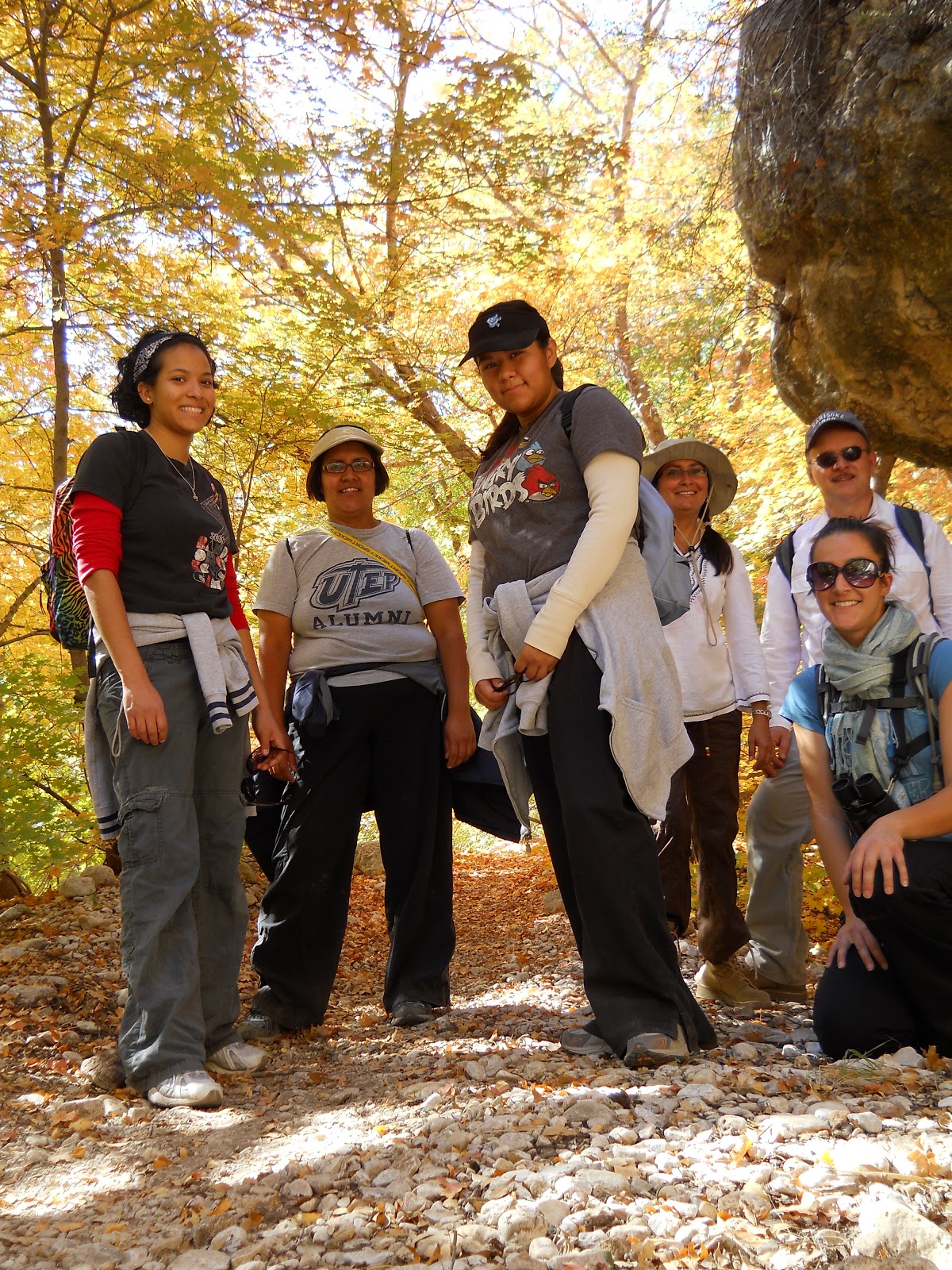
 A group picture amongst amazing colors.


 A sotol plant in the midst of Ponderosa pines and maples!  A crazy mix of biodiversity not found in many areas.

A group picture in the dry creek bed.

The Guadalupe Mountains have hiking trails for all different levels.  Only two hours outside of El Paso people can experience the beauty and solitude of nature.  Plan a trip.  Don't forget to bring lots of water and snacks for the trails.  There are also camp sites available.  Check out the website for more details - click here.

Guadalupe Mountains also has the highest peak in Texas at 8,751 feet.  Expect a blog sometime about the trek to the top because David and I are going to do it!  


Continue your adventure!

Saturday, October 22, 2011

My special buddy.

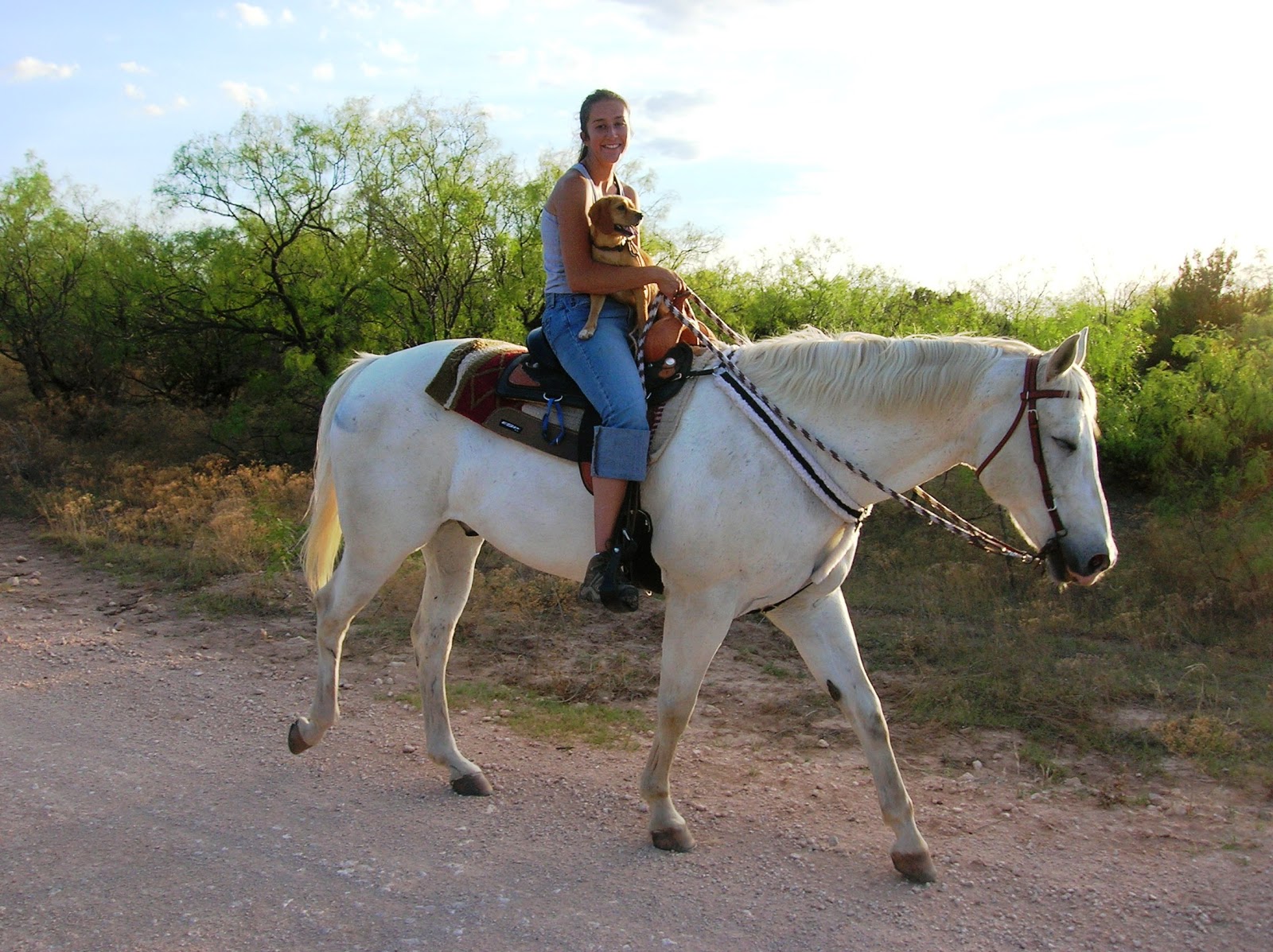
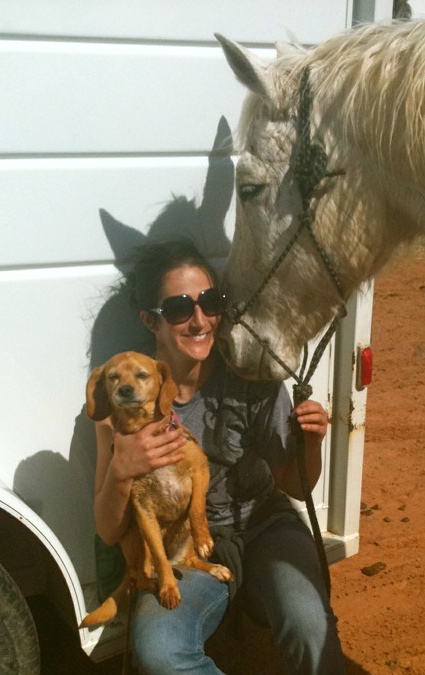
I recently lost a very special buddy of mine.  His name is Rocky and he was by far one of the best horses ever.

Rocky was obviously abused by a previous owner and when my mom first got him he was reluctant to get to know us.  We hung out a lot when I first moved to Texas for graduate school and slowly Rocky opened up.  Animals are incredible.  They can overcome anything thrown at them.  I am so happy that he was able to experience a fantastic last couple of years.  My mom provides her horses with five star luxury treatment and Rocky enjoyed every bit of it.

I am not a great rider, just a casual rider, but with Rocky it was easy, he did all the work.  In time we both trusted each other and basically I just let him do his thing.  He took care of me and I was just along for the ride. I trusted him so much that I often just let go of the reins, even when galloping through fields.  So much fun! 

Usually Rocky is a relaxed horse, but get him in a horse arena and wooooaaahh!  The first time I entered into the arena with Rocky I was complety thrown off guard.  He had the ability to bulk up and become a super horse and really I just got in his way.  He had obviously barrel raced in the past and I had obviously not.  I just held on and he did all the steering.  As soon as we exited the arena, back to the relaxed, chill horse I knew. 

His passing has reminded me to live your life.  Take the time out of our everyday busy lives to enjoy what we have.  And you know what - do what you want to do!  And cherish those who support what you do.  I wish I had more time with Rocky but he has left a huge footprint on my heart. 

Here are some fabulous pictures to describe some of our adventures. 

 This is how we were both happiest.  Bare back riding doing whatever we wanted.

 So handsome.  Enjoying Palo Senya.

 Someone is falling asleep. Always willing to let me do whatever.

 I jumped all over him and he did not care.

Ok so I let him eat a lot of grass when I rode.  Woopsie!

 Getting a bath after a ride in Palo Duro Canyon.


And he took care of everyone that got on him.

The next group of pictures came after my mom and I watched a Tommy Turvey horse demonstration which included Roman riding.  We (mainly I) were determined to give it a try but soon after giving it a go, we realized we needed to train the horses first to move as a unit.  The following pictures are just a few pictures of our escapades.  Take a look at Rocky in all of the pictures.  Amazing.  He is physically trying to stay underneath me and Apache (the paint horse) is running away the entire time.  Hilarious!

Apache, obviously freaked out and Rocky is probably thinking, what is crazy Naima doing now?

Rocky looks like he is saying, "STAY CLOSE TO ME APACHE"!

Look at the placement of Rocky's legs. :)

My two buds.  Miss Beaker is a bit scared!

I miss Rocky already and I wish we had hung out more recently.  Thanks mom for bringing him into my life and taking the best care of him!


Live your Life.